
Last month, I sat down with Gareth Bibby MBA, CIPD from APSCo and my colleague James Sun. Both know the recruitment world intimately. James led talent acquisition across Microsoft, Foodpanda, Blackstone, and Goldman Sachs. Gareth, through APSCO, sees the entire professional staffing industry from the inside.
What they shared wasn’t new. But it was real.
Recruiters are drowning in tools labeled AI. Yet when you watch them work, they’re still doing the heavy lifting by hand. Reading CVs. Spotting hidden keywords. Matching candidates against job descriptions line by line. Preparing battle cards for hiring managers. The AI label is everywhere. The actual AI-native workflows that make a recruiter’s day faster? Nowhere.
So I decided to build that, for James, Gareth, and all recruitment agencies alike. We called it Mamba Graph. Not everything that was technically possible made it into the product. Only what would actually change how a recruiter works.
Mamba Partners came on as the main distributor and platform operator. We shipped it to production. And earlier this week, with APSCO’s support, a demo of Mamba Graph was presented to recruiters and leadership from top agencies and in-house talent teams based in Singapore.
We didn’t build a replacement for recruiters. We built something that keeps them in control while removing the grunt work from their day.
Here’s a look at what was built and how it actually changes the game.
The core AI and agentic features
Autonomous CV analysis and candidate profiling
The old workflow: A recruiter receives a CV by email or download. They sit down and read it. They extract skills, assess seniority, note gaps in employment, evaluate communication style, estimate promotion velocity. This takes 15 minutes per candidate. Multiply that across a pipeline of hundreds of candidates and you’re talking about weeks of manual reading.
What Mamba Graph does: Upload a CV. The system reads it automatically, regardless of format (PDF or Word), extracts the raw text, and runs it through an AI model configured by the agency. It builds a 33-field structured profile. Beyond the basics — technical skills, programming languages, domain expertise, seniority level, career trajectory, employment gaps, promotion velocity, communication signals, cultural fit indicators — the analysis also produces a value proposition statement (why a hiring manager should care about this person), an ideal company profile (the company size, stage, and industry where the candidate performs best), motivation drivers, potential fit as a future hiring manager or client contact, three separate CV quality scores (clarity, completeness, and credibility), a list of recommended next actions for the recruiter, and an overall profile strength score. By the time the recruiter comes back, the full analysis is ready without any manual reading required.
The agentic part: The system doesn’t just extract keywords. It reasons about the candidate’s career arc, spots patterns in their growth, and flags anomalies. It runs two silent background checks before showing the analysis. First, it detects hidden text — a technique some candidates use to stuff invisible keywords into their resumes to fool basic screening. Second, it flags AI-generated resume content. Neither blocks the candidate. Both give the recruiter the information to make their own call.
Intelligent candidate-to-role matching
The old workflow: A new role comes in. The recruiter manually reads through their candidate database, comparing each CV against the job description. They build a shortlist by hand. This is hours of work per role. If requirements change, they start over.
What Mamba Graph does: After a candidate’s profile is built, the system automatically scores and ranks that candidate against every open role in the organization. It reads the role’s requirements description and uses AI to determine how well the candidate’s actual experience, skills, and seniority map to what the client needs. The recruiter opens a role and finds a ranked shortlist already populated. Not keyword matches. A reasoned fit score based on the full profile.
The agentic part: The matching engine reasons across the full candidate profile and the role requirements, weighing hard skills, seniority, career trajectory, and soft factors. When requirements change or a new CV comes in, the recruiter triggers a fresh match with one click. The system re-evaluates all candidates against the updated role.
Contextual battle card generation
The old workflow: Before presenting a candidate to a client, the recruiter spends 20 to 30 minutes preparing. They write a pitch paragraph explaining why this person fits. They go through the job description and the resume, checking off what matches and what doesn’t. They brainstorm screening questions tailored to the candidate and the role.
What Mamba Graph does: The recruiter opens a battle card for a specific candidate against a specific role. The system synthesizes the candidate’s full profile against the role’s requirements and produces three things: a recruiter-ready pitch paragraph, a scored breakdown of which requirements are met and which are gaps, and a set of tailored screening questions. The recruiter walks into a client conversation or candidate interview equipped with a contextual briefing that would normally take 20 to 30 minutes to prepare. If the role requirements change or the candidate profile updates, the recruiter refreshes the card and gets a new synthesis.
The agentic part: The system reasons about the fit holistically. It doesn’t just check boxes. It identifies which role requirements the candidate meets and which are missing, reflecting each gap in the fit score. It generates screening questions that probe the specific areas where the candidate’s background differs from the role’s needs.
Retrieval-augmented generation (RAG) candidate search
The old workflow: A recruiter needs to find candidates with specific attributes. They build complex filter queries across multiple fields. They manually review results. If they want to refine the search, they adjust filters and try again. This is slow and often misses candidates who don’t fit the exact filter criteria but would actually be good fits.
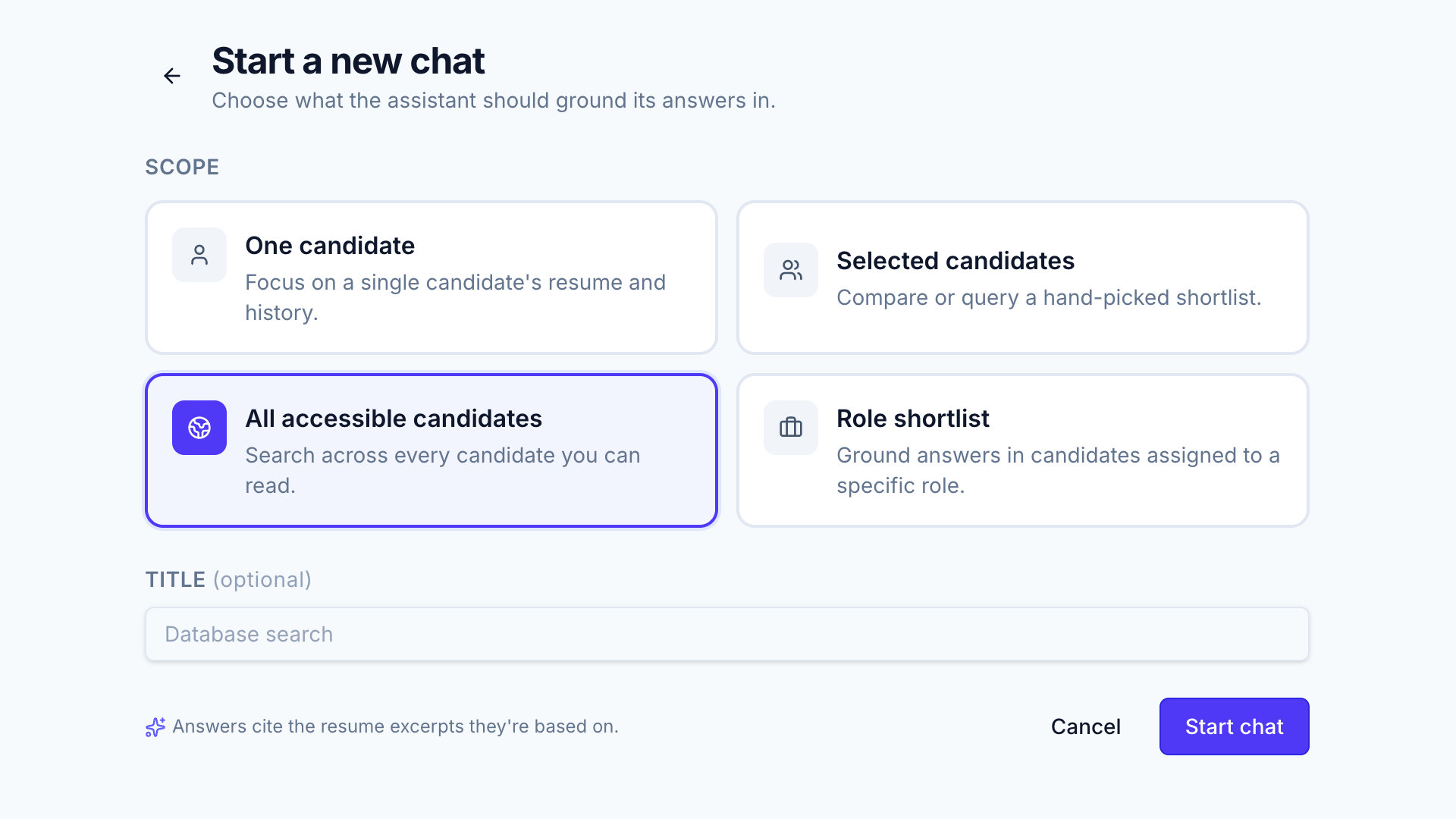
What Mamba Graph does: A recruiter opens the AI chat and describes what they’re looking for in plain language: “Find me a senior backend engineer with Rust experience who’s worked in fintech and is open to contract work.” The system searches across every CV the agency has ever indexed, retrieves the most relevant passages from those documents, and returns a reasoned answer with direct citations. Each citation is a clickable link to the exact candidate and the specific part of their resume that was referenced. The recruiter can refine the search through follow-up messages in the same conversation, narrowing by location, seniority, compensation expectations, or any other dimension.
The agentic part: The search is semantic, not keyword-based. The system understands what “senior” means in context. It knows the difference between someone who worked in fintech and someone who worked in a fintech-adjacent role. It can reason across multiple candidates and surface the best fits. It maintains full context across every message in the conversation, so a recruiter can refine their search through natural follow-up questions without restating their original query.
Role-scoped candidate comparison
The old workflow: A recruiter is filling a particular role and managing 10 to 20 open searches simultaneously. Before a client call, they need to compare candidates on the shortlist. They re-read resumes. They try to remember who has the strongest leadership experience or the most relevant sector background. They make mental notes. They get details wrong.
What Mamba Graph does: When a recruiter is filling a particular role, they can scope the AI chat to only the candidates assigned to that role. They can then ask comparative questions: “Which of these candidates has the strongest leadership experience?” or “Who on this shortlist has the most relevant sector background for a Series B fintech?” The AI reasons across the shortlisted profiles and surfaces a ranked, cited answer. A recruiter managing multiple open roles simultaneously can stay sharp on each search without re-reading every CV before a client call.
The agentic part: The system maintains context across multiple queries within the conversation. It understands the role deeply and can make nuanced comparisons. It doesn’t just count years of experience. It evaluates the quality and relevance of that experience.
Autonomous candidate pipeline management
The old workflow: A recruiter maintains a live pipeline. Candidates move through stages: Sourced, Screening, Interviewing, Offer Extended, Placed, Archived. The recruiter manually tracks where each candidate stands. If a candidate is being considered for multiple roles, the recruiter has to remember which stage they’re at for each role. Notes get scattered across emails and Slack. Activity timelines are lost.
What Mamba Graph does: The system maintains a live pipeline with clearly defined stages. At any moment, the recruiter can see exactly where every candidate stands across every active search. Candidates can be in different stages for different roles simultaneously. A senior developer might be at Offer stage for one client and just Sourced for another. The system tracks each candidate-role relationship independently. Every note is logged against the candidate. The system builds a timestamped activity timeline so you always know who spoke to whom and when.
The agentic part: The system generates background-generated digests that surface new high-fit matches between followed candidates and open roles. A recruiter doesn’t need to manually re-scan their candidate pool whenever a new role comes in. The system identifies new potential placements autonomously and brings them to the recruiter’s attention.
Secure candidate profile sharing
The old workflow: A recruiter needs to share a candidate with a hiring manager. They export the resume to PDF. They copy and paste information into an email. They create a guest account in the system or share login credentials. They worry about data security. They can’t revoke access cleanly.
What Mamba Graph does: The recruiter generates a secure share link directly from the candidate profile. That link requires no login and can be sent by email or Slack. Before generating it, the recruiter decides exactly what the recipient can see: the basic profile and contact summary, the full resume download, the AI analysis, or all three. The link can be revoked at any time. Hiring managers get a clean, professional candidate dossier on a dedicated page. The agency never has to grant a client access to the internal system, create guest accounts, or export anything to a PDF manually.
The agentic part: The system enforces granular access controls at the point of link generation. It maintains audit trails for share link creation and revocation. Every decision about what information a recipient can see is configured and logged by the recruiter at the time of generation.
The operational backbone
Beyond the AI features, the system handles the operational work that used to require manual administration.
Candidate and role management: Recruiters build out a structured client book inside the platform. Each company has its own record, and under each company sit the active, paused, and closed roles the agency is working. Roles carry the information that makes AI matching meaningful: seniority level, compensation range, and a detailed written description of what the client actually needs. The quality of the role description directly determines the quality of every AI output connected to that role.
User and access administration: A platform admin approves or rejects new recruiter signups before they can access any candidate data. They can promote team members to admin, grant or revoke platform access at any time, and set per-user access expiry dates for contractors or temporary staff. If a recruiter’s account needs to be suspended immediately, the admin revokes platform access in one click and that user is locked out on their very next request.
Trial and subscription management: When a new recruiter joins the platform, they automatically receive a trial period (14 days by default, configurable by the admin) during which they have full access to end-user features. Admins can define multiple subscription tiers, each linked to a Stripe price and feature flags. Recruiters subscribe through a checkout flow and manage their billing through a self-service portal.
Audit logging and compliance: Every meaningful action in the system is written to an immutable audit log with the acting user’s identity and timestamp. If a question ever arises about who approved a user, when an AI analysis was run, or when a share link was created or revoked, the answer is in the log.
Resilience and recovery: If the server restarts mid-analysis, any CV that was being processed doesn’t get stuck permanently. The next time the server boots, it scans for interrupted jobs and automatically re-queues the pipelines. Recruiters don’t need to manually re-upload CVs or diagnose why an analysis never finished.
What this actually means
This isn’t just about recruitment. It’s about how you build AI products.
Start with technology and you build features. Start with the work and you build something that actually helps. Mamba Graph works because it respects how recruiters actually work. It takes the manual stuff off their plate so they can focus on the part that matters: talking to people. The best AI tools don’t change how people work. They just make the work they’re already doing faster and clearer.
If your organization is interested in using Mamba Graph, reach out to James Sun. He’s leading the go-to-market effort and can walk you through how it works for your team.