
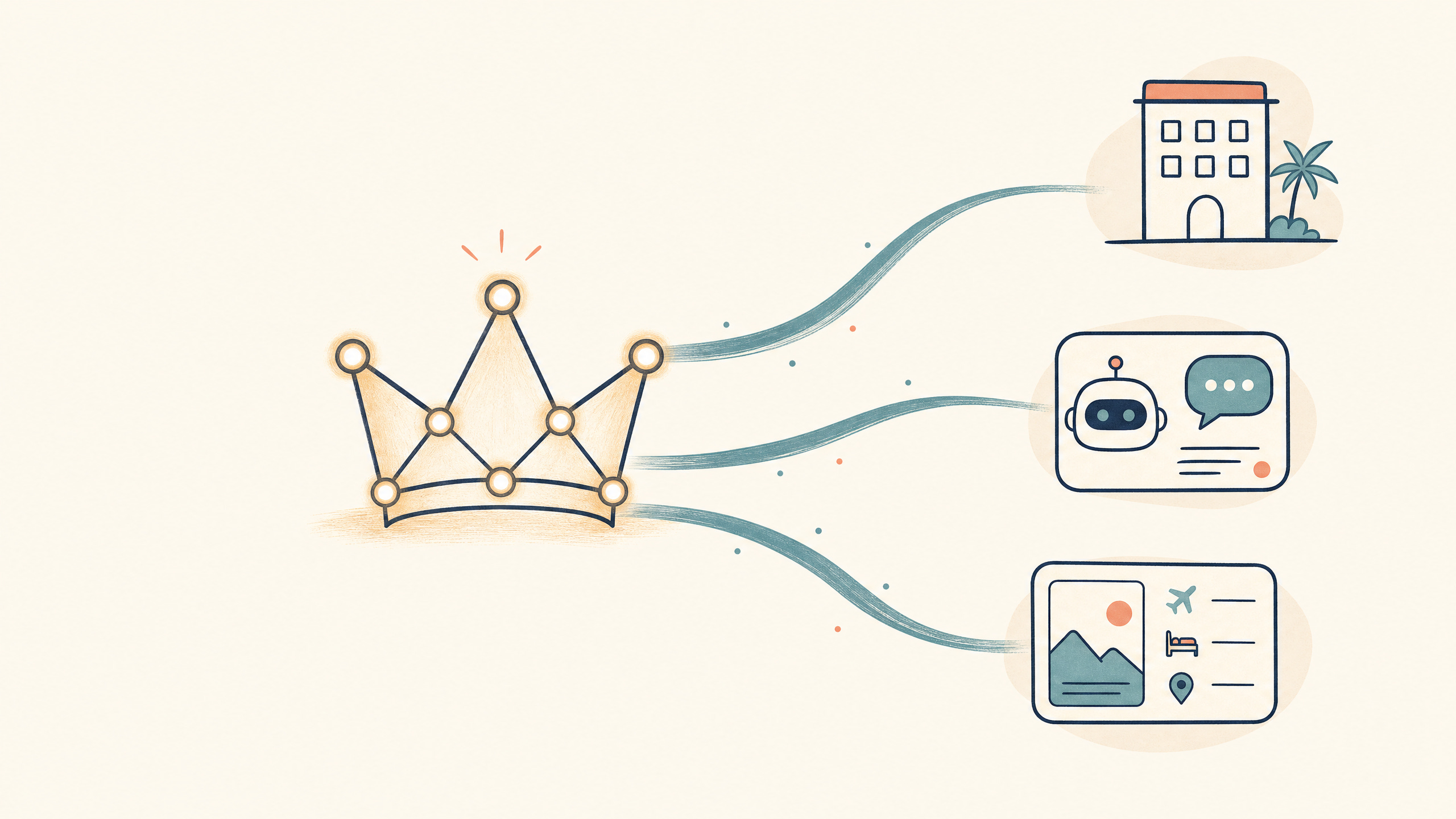
I remember looking at hotel inventory in Singapore and realizing that, inside an online travel agency, or OTA, platform, a room is not really a room.
To the guest, it is a weekend stay, a small escape, or a family decision. To the platform, it is content. And if that content is not connected, updated, trusted, and distributed, it does not matter how good the room is.
That is a lesson I keep relearning in different industries.
Great content matters. Great supply matters. Great products matter. But until they are distributed well, they remain potential energy.
A hotel room is not just a room. Inside the travel tech value chain, it is content. An OTA needs content so guests can discover, compare, trust, and book. The more unique and reliable that content is, the stronger the platform becomes.
But content does not move by itself.
To make a room bookable, the OTA needs connectivity. Hotels use property management systems and channel managers. Rates, availability, room types, restrictions, packages, photos, policies, and inventory need to move constantly between systems. If this layer is weak, even good supply becomes invisible or unreliable.
That was one of the lessons I learned while serving as the Chief Technology Officer (CTO) of a new OTA player in Singapore.
During that period, Singapore Tourism Board launched the SingapoRediscovers Vouchers program. It was a simple idea with a lot of operating depth behind it. Give citizens digital credits, make domestic tourism more accessible, and stimulate the local tourism economy when international travel was heavily restricted.
I still think it was a strong strategy. It did not only create demand. It distributed value.
For the campaign to work, hotels, attractions, tours, packages, payment flows, voucher redemption, and user discovery all had to connect. Traveloka, as one of the authorized booking partners, described more than 100 hotel inventories, over 1,000 room types and packages, more than 100 attractions and tour partners, and over 200 experiences available to users through its platform.
That is not just marketing. That is infrastructure becoming visible to the end user.
The user sees a voucher and a booking flow. Underneath it, there is supply aggregation, content freshness, platform trust, campaign design, partner onboarding, and distribution.
This is where I think many founders, including myself at times, underestimate the importance of distribution.
We like to believe that if the content is good enough, people will find it. Sometimes they do. Most of the time, they do not. Value needs a path. Content needs connectivity. Supply needs access. A platform needs distribution.
Earlier this year, I built an open source project called VisitKorea AI MCP Hub, released under the MIT license.
The motivation came from a similar pattern.
Korea has rich tourism content. The Korea Tourism Content Lab, built by the Ministry of Culture, Sports and Tourism and the Korea Tourism Organization, is a digital tourism content platform that brings together tourism information, images, videos, and other assets. It contains around 700,000 records, including multilingual tourism information and high-quality images, and makes them available through APIs.
That is valuable content.
But in the AI agent era, I do not think availability alone is enough.
If tourism content is going to reach the masses, it needs to be available through the protocols and interfaces that modern builders and AI agents actually use. It needs to be easy for an agent to search, retrieve, reason, plan, cite, and produce something useful for a real person.
That is why I built three MCP servers.
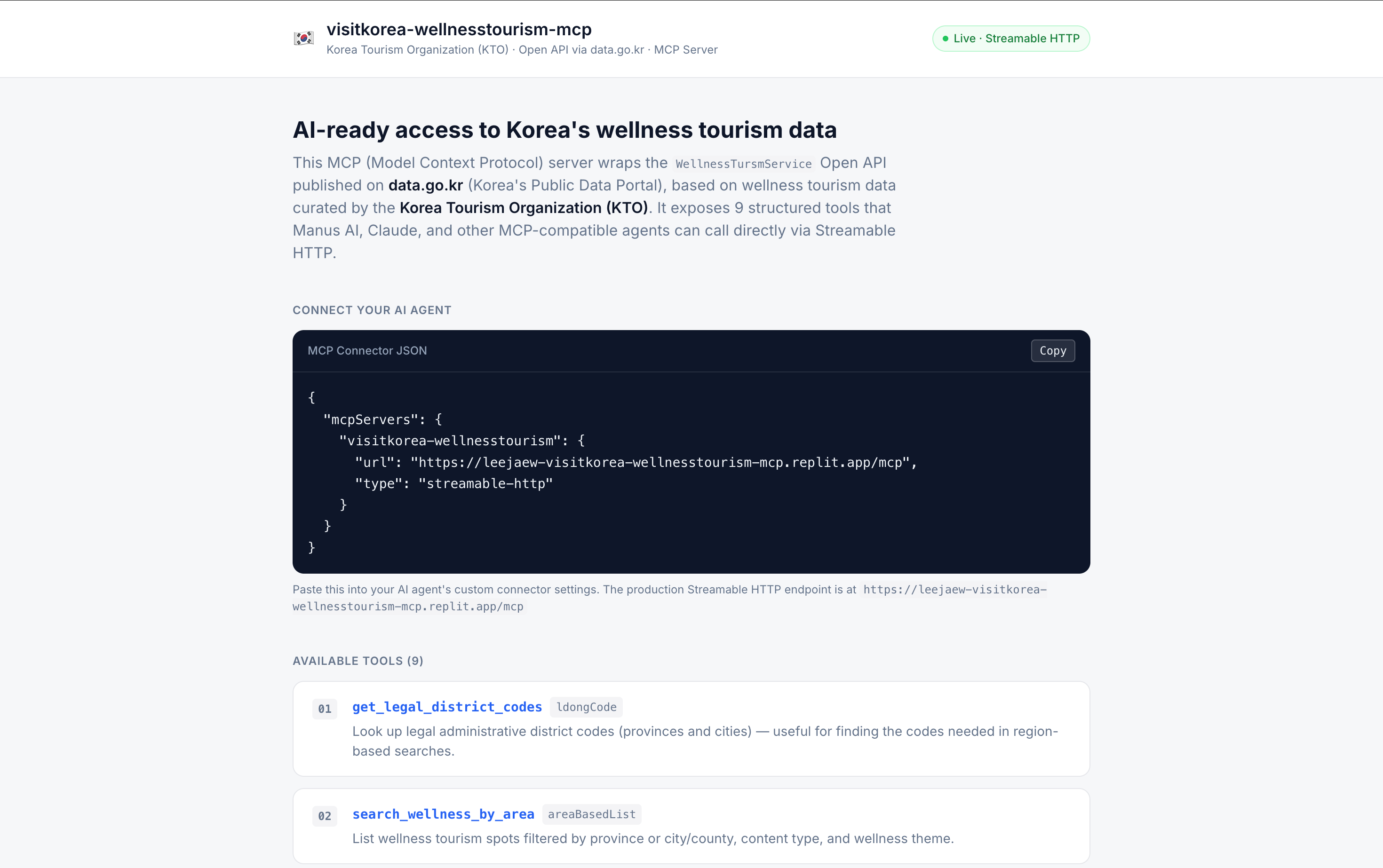
The first is the general VisitKorea tourism MCP server. It gives AI agents access to tourism information such as attractions, regions, places, images, and destination details. This is the base layer for discovery.
The second is the medical tourism MCP server. It focuses on Korea’s medical tourism information, including clinics, hospitals, specializations, and foreign-patient-oriented services. This matters because medical tourism has different trust, context, and decision requirements than leisure travel.
The third is the wellness tourism MCP server. It exposes wellness destinations such as spas, healing centers, meditation, nature-based experiences, and wellness-related facilities. This is important because wellness travel is often less transactional. People are not only looking for a place to visit. They are looking for recovery, balance, and a certain emotional state.
Together, these servers turn static public data into something an AI agent can actually use.
I saw this become real in two use cases.
The first was when I was planning a trip to invite a Saudi conglomerate to visit Korea. This was not a casual itinerary. The context mattered. The trip needed to respect business expectations, cultural fit, time constraints, hospitality standards, and the kind of Korean experience that would feel both premium and meaningful.
A generic travel plan would not work.
The agent had to think through who the guests were, why they were coming, what kind of impression Korea should leave, and how the schedule should balance meetings, cultural exposure, food, rest, and movement. The content needed to be curated, but the distribution layer made it possible for the agent to assemble the plan quickly from reliable data.
The second use case was more personal.
A former colleague of mine, originally from the United States, had never visited Korea. He was planning to come with his family and had a young child. The criteria were completely different.
This was not about executive hospitality. It was about comfort, pacing, child-friendly experiences, jet lag, food choices, hotel location, airport transfers, and avoiding the mistake of over-planning a family trip.
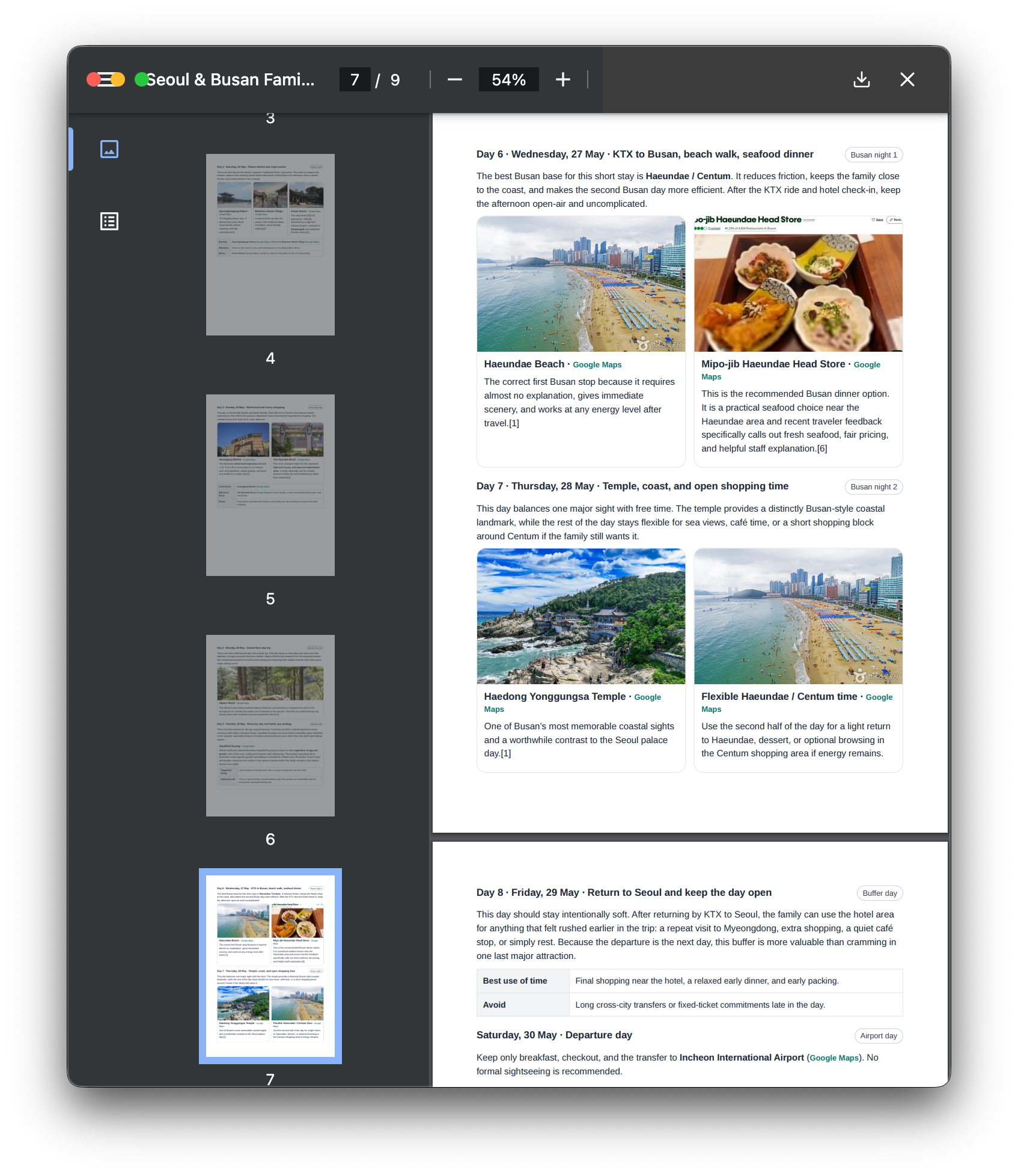
The agent helped create a full travel plan that considered those constraints. It used the MCP servers to gather source-backed tourism and wellness information, then produced a ready-to-use PDF itinerary that the family could actually carry into the trip.
That was the moment the pattern became clear again.
The value was not only in the data. The value was in bringing the data close enough to the user’s real decision.
A family does not want an API. A business guest does not want a database. A traveler does not want 700,000 records.
They want a plan that fits them.
This is where AI agents can create immediate value. Not by replacing the travel industry, but by connecting parts of the value chain that are still too far apart.
Public data is often far from the user touch point. Hotel inventory is far from emotional intent. Wellness content is far from actual recovery. Medical tourism information is far from trust. APIs are far from decisions.
The opportunity is to close that distance.
That is what distribution really means to me now.
It is not only paid ads, SEO, SEM, campaigns, or performance marketing. Those matter. I have seen how much they matter. But distribution starts earlier than marketing.
Distribution starts when value becomes reachable.
In travel, this means fresh inventory, channel connectivity, searchable content, trusted booking flows, and clear user journeys. In AI, it means modern protocols, agent-ready tools, useful schemas, and workflows that produce outcomes instead of raw data.
The founder lesson is simple, but not easy.
Do not confuse having value with distributing value.
High-quality content is important. But if it cannot travel through the right channels, into the right tools, at the right moment, for the right user, it stays locked inside the system.
Content is the asset.
Distribution is the path.
And in most markets, the path is still where the company is built.